Research plan proposal
|
Provider‘s code |
MSM |
|
RP identification code |
6215648905 |
|
Research plan title |
Biological and technological aspects of
sustainability of controlled ecosystems and their adaptability to climate
change |
|
Applicant |
Mendel University of Agriculture and Forestry Brno |
|
Administrator |
Faculty of Agronomy |
|
Investigator |
Ass. Prof. Zdeněk Žalud, Ph.D. |
A
Research plan description
A1
Subject and goal of the research plan
|
The presented
research program deals with a multidisciplinary research of managed
ecosystems and is oriented to biological and technological aspects of their
sustainable use. The project should contribute to the optimization of the use
of these ecosystems in such a way that their productive capacity will be
preserved, and kept in a mutual harmony with all other functions which these
systems provide. Its focus, structure and goals justify the preference of an
anthropocentric approach to ecosystems, which uses for their individual
functions the term services. Regarding the fact that biological and physical
framework, in which these ecosystems function, is not static but
significantly modified by the current of global climatic change as well as
other factors, it is necessary to consider and carry out the research of
those adaptive measures that assure the sustainability of ecosystems in the
course of these changes. The research team is convinced that the use of the
Czech territory, which is based mostly on controlled ecosystems, would
support research that is very desirable, especially if we want to minimize
existing environmental risks and to assure a long-term multifunctionality of
the landscape. The research project corresponds with the current concepts of
change in European agriculture, which assumes a gradual reduction of energy
inputs and emphasizes those functions that concern landscape, soil protection
and water management as well as the establishment of a harmony between these
functions on the one hand and the productive function of the landscape on the
other. The core of the
research is represented for managed agricultural ecosystems, arable land,
grassland, water resources and energy-producing woody species and is the
basis of all current research activities of the Faculty of Agronomy, Mendel
University of Agriculture and Forestry in The second
objective of the research project is to evaluate the individual ecosystem
services that are provided by managed ecosystems or could be provided under
current and expected climatic conditions. In our case, this means above all
creating a harmony and sustainability of their productivity, regulatory,
cultural and supporting functions. Knowledge
of internal relationships and functions of ecosystems is an internationally
accepted scientific and political priority. Problems concerning
sustainability of the development in the landscape or in the managed
ecosystems as well as impacts of climatic change represent a
multidisciplinary issue and cannot be effectively solved on the level of
small research teams and projects of classical character. In this context, it
should be mentioned that many studies emphasize an extraordinarily
challenging financial, managerial, and experimental requirements to
accomplish the research and it is systematic and long-term implementation. On
the national level only research projects based on a suitable methodology and
provision of both human and material resources can provide a platform for
such research activities. These enable a broad collective of researchers to
find answers to the extraordinarily complex questions like: ‘What are the
optimum ways to create a sustainable landscape?’ and ‘How can the climatic
changes influence the character of the landscape?’. The current climatic
changes have generated many hypotheses concerning future behaviour of both
managed and non-managed ecosystems. In the presented research project, we
will try to confirm or deny some of them. For a long time the negative
effects of climatic changes on ecosystems are held as one of the most
important scientific and research priorities. Another important reason why
this research should be implemented is the fact that there is no other
complex project that would deal with these problems within the framework of
managed ecosystems in the This proposal respects and significantly corresponds
with the first theme of „Major Long-term Directions of the Research“ that was
accepted by the Government of the Czech Republic under the name “Sustainable
Development (Biological and Ecological Aspects of Sustainable Development)”
on 1 June 2005 |
A2Present level of knowledge and
research activity in sphere which is subject of the
research plan, from both international and
national standpoints
|
Natural ecosystems that made up the
living environment of the human race for a considerable part of its
phylogenesis had a very characteristic feature, viz. the capability of
self-regulation, which resulted from a complex and complicated network of
both positive and negative feedbacks and which were determined by internal
limits of each ecosystem. In natural ecosystems such autonomous regulation represented, to a
great extent, that function of mobility of both plant and animal species
contributed also to the processes of evolution (Mebratu, 2000). Some 8000
years ago the human population limit
reached The
objective of the presented research project is not a new definition of the
term of sustainable development or to discuss all its aspects. We are fully
aware of the fact that it is not possible to separate its social and economic
aspects and in our understanding the term sustainable development means a
simultanous fulfilment of three requirements suggested by Robinson and Tinker
(1997): 1.
Ecological
imperative – the development only within tolerable biological and physical
limits of the environmental capacity; 2.
Economic
imperative – the development, which assures adequate material conditions for
all groups of citizens; 3.
Social
imperative – the development, which enables to adopt both principles
mentioned above into the context and code of widely acceptable social values. According to Robinson (2004), this can be reached only through a decrease in the energy consumption per unit of economic production associated with a simultanous increase in its contributions for the society. If such a developmental trend can be understood and perceived as sustainable will be dependent on concrete political, social, economic, and ecologic interests. Similarly, sustainable development as
an eocnomic activity taking place within certain biological/physical limits,
we also perceive the environmental problems as a result of interactions
between the biosphere and civilisation (van der Leeuw, 2001). People are
dependent on ecosystems (that in this concept involve systems of a managed or
intensively tended landscape of
Central Europe) due to the fact that they need the services, which
they provide (de Groot, 1992; Daily, 1997). These involve above all of the
productive services (i.e. weather regulation, pollination etc.), cultural
(i.e. spiritual. recreational and aesthetic values of ecosystems themselves)
and, finally, supporting services (e.g. pedological processes, turnover of
elements and energy etc.). These services (Fig. 1) not only assure the basic
preconditions of life but also influence markedly socio-economic and
interpersonal relationships (MEA, 2003). The idea of ecosystemic function and
services incorporates the human race into a complex system of mutual
relationships within which it is perceived not as superordinated entity but
as an integral part of these systems (Palmer et al.,2004, Turner, et
al., 2003). The concept of ecosystemic services, as described in the
publication Millenium Ecosystems Assessment (MEA, 2003), represents one of a
few applicable ways to describe in a complex manner multidimensional
relationships between man and the environment without being entrapped in a
methilogical mesh of either exagerrated reductionalism or approaches that are
too generalized. The
picture today of Central Europe (and the majority of developed countries) has evolved through a
gradual substitution of natural ecosystems by managed ones. These are
considerably influenced by and dependent upon the presence of man and have an
attenuated function of autonomous regulation. When neglecting human settlements
and forests with primarily productive functions, it can be said that
agricultural land, water, streams and artificial water reservoirs dominate in
managed ecosystems of our countryside. The structure of such systems are much
simpler and more uniform than that of natural ones and, as a rule, they are
unilaterally oriented toward production. It is important to note that such
systems consume much energy and in their essential form, they are only rarely
compatible with principles of the sustainable development. At the same time,
however, they have certain reserves that (within the framework of
optimisation of processes that take place in them, e.g. when using
biotechnologies or self-regulation etc.) can contribute to the reversal of
some generally negative trends. Intensive
(quantity-oriented) agriculture with its wide use of mineral fertilisers,
pesticides and agricultural machinery causing a gradual destabilisation of
agroecosystems and environmental pollution is a classical example of a
non-sustainable managed system. This was characteristic for the whole
territory of the Czech Republic within the period of 1970 – 1990. During the 1980s, however, people realised that problems that result from
this use of the landscape cannot be
solved individually and ad hoc, but that they require a more
comprehensive, integral and sustainable approach to the problem of
agricultural production. Several new approaches were suggested, e.g. the
system of sustainable (Allen & Van Dusen, 1988; Edwards et al., 1990),
integrated (Vereijken & Royle, 1989) and alternative (organic)
agriculture (National Research Council of USA, 1989). These approaches and a
new comprehension of the role of managed systems (above all agricultural)
were gradually incorporated also into a very powerful tool that represents
the Common Agricultural Policy (CAP) of the European Union and were
excellently formulated in conclusions of the Commission fof Agriculture
(EU-Commission, 1997; 2005): „European agriculture as an economic sector
must be versatile, sustainable, competitive in all of Europe (including Less
Favoured Areas and mountain regions.
It must be capable of not only to
maintaining the character of the countryside, to protect the natural bounty
and to contribute to the viability of rural communities but also to satisfy
the demand for safe and quality foodstuffs when observing all standards
concerning the environmental protection and animal welfare.“ There is no
doubt that the current European agriculture is at the start of a new stage of
its development and that it also reflects discussions concerning its
sustainability. It results from existing analyses that the yields of a number
of crops increased by more than 300% within the recent 50 years (Amthor,
1998) and that the substantial part of this increase was partly due to
technological innovations and partly due to an increased intensity of
production. If the present rate of growth of production were mantained, only
50% of the present area of agricultual land would be necessary for production
in EU in 2080 (Rounswell et al., 2005). This, on the one hand,
represents a serious socio-economic problem but it is also an extraordinary
opportunity for the optimisation of the ratio existing between individual
ecosystemic services, the increase in the versatility of the way the landscape is used, and the increase in abundance of both plant
and animal species on the other. There
is also a possibility to use a part of this released productive capacity for
a massive cultivation of energy-containing crops and for an active support
of, until now, neglected ecosystemic services. However, the implementation of
this vison is dependent on factors of political and economic environment of
existing managed systems as well as on an exact defiition of parameters of
their biological, physical, economic and social sustainability within the
framework of the individual regions. In the Czech Republic, individual
aspects of ecosystem sustainability (from co-ordination of research
activities themselves) are implemented above all by the Ministry of
Environmental Protection, Centre for Environmental Problems of Charles
University, Czech Ecological Institute, Czech Hydrometeorolgical Institute,
Research Institute of Water Management TGM, Minsitry of Health, Ministry of
Local Development, Institute for Ecopolitics and others. Problems related to
studies on sustainability of ecosystems in the CR are directly linked with
European trends and Czech experts participating directly in elaboration of a
number of key documents (e.g. MEA). One of the best known publications that
contributed to the discussion about the sustainable development was the
„Report about the Environmental Situation in the Czech Republic“, which was
issued in 1993, which involved a system of environmental indicators (the so-called
core set) used in OECD countries. Moldan (1996, 2003) discussed problems
associated with the sustainability of managed systems from the viewpoint of
envornmental protection and Nátr (1998, 2005) paid attention to aspects
concerning food production. The above authors published complex and
integrated visions of sustainability of ecosystems and their endangerement
resulting from climatic changes. However, it is necessary to mention that
only a lesser part of Czech publishing activities is based on results of
original research studies performed within the framework of the Czech
Republic; this is probably associated with the interdisciplinary character of
the concept of sustainable development and relatively high costs which are
beyond financial frameworks of common research grants. Moreover,
the complexity of problems related to the sustainability of ecosystems is
further amplified by current global climatic changes that surely will
change basic environmental conditons
and, thus, also the sustainability of existing systems. Besides, the climatic
change itself is a direct consequence of industrial revolution and proof of
the neglect of the current approach to the use of natural resources. In
principle, this concerns above all exploitation of the productive ecosystemic
service at the expense of services of a regulatory nature. The amplification
of the greenhouse effect resulting from a dramatic increase in the release of
radiation-active gasses (CO2, CH4, N2O and
freons) is their major cause (IPCC, 2001). The first consequences of climtic
changes were more markedly manifested already in the 1990s (IPCC, 2004).
Although in the geological history of our planet there were several changes
in the climatic system (including the alternation of glacial and interglacial
periods that was typical for the Quarternary), these anthropogenous changes
have no analogy within the last 1,200 years (Osborn, Briffa, 2006). An
alteration of
relatively stable thermal and precipitational conditions will seriously
influence not only all managed ecosystems in the territory of Central Europe
but also the remnants of natural ones, because in many cases they are on the
fringe of their biological and physical sustainability. Globally, the present
level of production will be markedly influenced and the disparity existing
between individual regions that will be considerably increased (Parry et
al., 2004) and within the framework of individual pedo-climatological
regions of Central Europe (Trnka et al. 2004). It can be expected with a high degree of
probability that for instance an earlier occurrence of temperature sums
resulting in an acceleration of temperature-dependent phenological
development, a marked incrase in the total number of tropical days (i.e. days
with the maximum temperature ≥
This basic survey of expected changes and their consequences only
indicates the necessity of detailed
studies on the biological and physical framework of sustainable development.
we are convinced that a combination of the pressures on sustainability of
production with current climatic changes is associated with a necessity of
re-evaluation of our existing approaches to the analysis of sustainability of
the managed systems. In each of them, it will be necesasry to identify and
optimize the provided ecosystemic services, to analyze their vulnerability
under the changing climatic conditions and to suggest a set of suitable and
sustainable adaptive measures. These measures should leed to a better use of
the productive and regulatory ecosystemic services, to a decrease in
production of greenhouse gases (for example through the use of free
production capacity for cultivation of energy-rich crops and sequestration of
carbon dioxide), to an improved resilience of the landscape in the Central Europe
to hydrometeorological extremes and to a preservation of and possibly also
increase in the abundance and biodiversity of plant and animal species. The
main ambition of the presented research project is to carry out an
interdisciplinary research in this field and to contribute to an
implementation and a practical application of ideas of a sustainable
development of agricultural acitivites with a simultaneous alleviation of the
impact of expected climatic changes on managed ecosystems that cover more than
a half of the territory of the Czech Republic.
Fig. 1: Ecosystemic services
and their links with the standard of living (Ministry of Environmental
Protection, 2003). Ecosystemic services are benefits that
people can obtain from ecosystems.
They involve a provision of goods, regulatory and cultural services
that influence people directly and their supporting services which are
indispensable for the maintenance of all other services. Changes in these
services influence the standard of living of people through the impact on
their safety, basic preconditions of their competence, health, social and
cultural relationships. These most important components of this standard influence the human freedom and
possibilities of free choice. |
A3
Sub-goals of the research plan
|
The goal of the proposed research project is to analyze the
sustainability of some managed ecosystems with regard to their biological and
physical sustainability on the one hand and economic and social
sustainability on the other. The analytical part of this study, based on
results of our experimental activities, will be used as a base for the
proposal and testing of optimisation measures in those fields, in which their
functions will be not acceptable. At the same time, we will try to evaluate
the adaptability and an overall vulnerability of ecosystems under conditions
of climatic changes and a long-term efficiency of current measures leading to
the sustainability of managed ecosystems and providing ecosystem services.
Although each ecosystem will be evaluated separately, the whole research will
be co-ordinated and an analogical methodology will be used in two regions
under study (i.e. in the The
final goal, which is common for all managed ecosystems, can be reached by
means of the application of the following schematic procedure and solving of
individual partial goals (PG): PG 1: Identification of ecosystem services provided
(or virtually provided) by the managed ecosystem on a local level An ecosystem is a
dynamic complex of abiotic factors and associations of plants, animals and
microorganisms, which create a functional unit on the basis of their mutual
relationships. It has limits, which determine interactions of its individual
components. In case of a managed ecosystem, the man and his activities, which
are usually oriented to a strengthening of ecosystem services,
represent one of its basic components. These are defined as benefits
that people can obtain from ecosystems and their partial survey and
interrelationships are presented in Fig. 1. The professional orientation of
the research team its activities will be focused above all on the groups of
supporting services, providing services and regulating services. Experimental stations have been
established for each managed ecosystem (see Part C1); ecosystem
services will be evaluated in all of them (see Tab.1), together with those
that are of a virtual nature. The partial goals will be studied on the level
of: 1.
functional units of different size (e.g. individual
plots, cadastral territories, model and local watersheds and/or farms,
regions and in some cases also NUTS2); 2.
units with different climatic conditions ( 3.
systems with different methods of husbandry (e.g.
organic vs. intensive); 4.
economic units with different orientation (plant vs.
animal production). From this point
of view, the research project has two specific features: complexity and
orientation to regional and lower level (in contradistinction to the current
EU projects ATEAM or ACCELERATES that were focused to continents, countries
and only sporadically also NUTS2). This process will involve groups of
stakeholders who are clearly interested in the use and quality of provided
ecosystem services (farmers, representatives of Agrarian Chamber, employees
of water-managerial institutions, operators of agrotourism etc.) and who also
can help to direct research activities closer to factual practical problems.
The final portfolio of ecosystem services, which will be studied within the
framework of the research project, will be defined by a group of heads of
individual research stages and invited experts. However, the structure of the
research project is drawn up in such a way that it should enable the possible
involvement of other ecosystem services and indicators (based on the results
obtained). The basic precondition of the fulfilment of PG 1 is the
establishment of new and/or the adaptation of existing experiments and
creation of a wide experimental base that will enable testing of individual
methods, analysis of systems links and investigation of model adaptation
measures leading to the optimisation of ecosystem services. The proposed
experimental base starts with capacities that are already partly available in
the workplace of the applicant and will consist not only of territories
already managed in a standard manner but also of semi-pilot experiments of
multifactorial field experiments. Which are the expected results? a) Identification of
ecosystem services within individual ecosystems; b) Proposal and launching of
field and long-term experiments (or a modification of existing ones); c)
Organization of workshops for stakeholders. PG 2: Pilot testing of the set of quantifiable
indicators which enable a description of the sustainability of ecosystem services In
spite of the fact that a number of institutions deal with the development of
indicators, their definition and numbers are often very disputable. An indicator
of sustainable development contains a certain type of quantitative or
semi-quantitative information, which is derived from primary data and
provides complete information about a certain characteristics of the
ecosystem services. A complex of suitable indicators can be then used to
analyze the sustainability of individual managed ecosystems. For that reason
all indicators must meet certain basic preconditions. This means that they
must be: (1) analytically well-founded and justified; (2) measurable,
estimable or computable; (3) arranged into suitable time series; (4)
comparable in an international scale and (5) policy relevant and addressed to
a given policy and or political measure. This means that
the second partial goal is the selection and methodological definition of
those indicators that will suitably describe ecosystem services provided by
ecosystems under study and, at the same time to evaluate their sustainability
on the basis of their aggregation. The first proposal of considered
indicators is presented in Tab. 1 and will be further specified and refined
in the course of solution of PG1 and also within the framework of a dialogue
with stakeholders. (As mentioned above, the research project is an open
system that enables to look for new indicators that could be also involved).
This is due to the fact that above all on the local level (in concrete
localities mentioned in parts A6 and C1) it is often possible to discover
some local, specific links that may require the development of new
indicators. Based on an aggregation of indicators, which are bound with a
certain ecosystem service, it will be possible to define those that represent
an obstacle for the sustainable development within the framework of a given
group; at the same time, they can also evoke the solution of a further
partial goal. Which are the
expected results? a) An exact and methodological specification of
indicators describing ecosystem services provided by managed ecosystems; b)
Identification of those indicators that probably participate in the
„non-sustainability“ of managed ecosystems. PG 3: Elaboration of methodology of work with
indicator sets and testing of their practical informative value This is the key goal
of the whole research project. The elaboration of methods enabling to define
indicators and intervals of virtual (and above all sustainable) values of
indicators will be of cardinal importance for the evaluation of
sustainability of ecosystems. Regarding the fact that similar sets of
indicators are used within the framework of PG2 (Tab. 1), it will be possible
to generalize and compare potential values of individual indicators. This
verification will be carried out on the base of existing and newly
established experiments in such a way that robustness and correctness of
obtained data will be warranted. The testing of calibrated sets of indicators
under semi-pilot and field experiments will be especially important because
they can be thereafter used for analysis performed in a regional (and
possible also national) extent. In some cases, the elaboration of indicators
will be a relatively simple affair but in others, this will require even
several years of research. Which are the
expected results? a) Elaboration of a methodology for each indicator;
b) Verification of indicators by means of experimental data; c) Verification
of the informative value of indicator sets, i. e. of their credibility and of consistency of
the description of a given ecosystem. PG 4: Complex evaluation of individual managed ecosystems and proposals of their optimization from the viewpoint of biological and technological aspects of sustainability The tested sets of indicators with a
defined functional range will be used when evaluating the sustainability of
managed ecosystems. The sustainability of each ecosystem will be evaluated on
the basis of a complex analysis of individual indicator values. Among others,
this should enable identification of problematic phenomena contributing to a
potential non-sustainability of the ecosystem and to propose solutions. This
PG will also involve an optimized proposal of the arrangement of a managed
ecosystem (in several variants) that not only will be sustainable from the
viewpoint of biological and physical processes but that will also feasible
from the technological point of view. The proposal of an optimized solution
(or at least of its part) will be then tested under experimental conditions
and the obtained results (indicator values) will be analyzed. When solving
PG3 and PG4, teams working on stages 1-5 will co-operate (see below) because
within the landscape it is not possible to optimize one managed ecosystem
with out regard to others. For this reason it is planned to study the
relationships and linkages existing between individual managed ecosystems in
the landscape. The obtained results will be discussed with stakeholders with
the aim of a verification of their wider implementation. Which are the
expected results? a) Evaluation of individual aspects of
sustainability of ecosystems with an emphasis on their biological and
physical aspects; b) Identification of problematic phenomena endangering the
sustainability of ecosystems and verification of possible remedies; c)
Proposal of measures leading to an optimization of ecosystems and their
mutual relationships with the objective to assure their sustainability even
under different climatic conditions. PG 5: Analysis of vulnerabity and sustainability of managed ecosystems under conditions of climatic change In the course of
the first stage of solution of the research project, this PG will be focused
to an evaluation of sensitivity of proposed indicators (and, subsequently,
also of complete managed ecosystems and ecosystem services) to those
meteorological and climatologic phenomena and processes that influence the
sustainability of ecosystems under current climatic conditions. These
concerns above all have an analysis of sensitivity of indicator values
obtained within the framework of earlier (sometimes several decades long)
experiments and their influence by: (i) basic climatic characteristics of a
given region; (ii) annual, monthly and daily variability of climatic
conditions and (iii) extreme hydrometeorological phenomena. At the same time,
the obtained data about managed ecosystems and their services will be
integrated into ecosystem models (e.g. dynamic models of growth and development
of field crops; models of grassland ecosystems or rapidly growing woody
species ecosystems) in such a way that it will be possible to quantify
complex bounds existing between meteorological and climatic factors on the
one hand and processes taking place within managed ecosystems on the other.
It is also planned to develop supporting climatologic, pedologic, orographic
and socio-economic databases, which should be a base for a generalization of
outputs of PG1-4. Regarding the fact that the sustainability of managed
ecosystems must be envisioned from a long-term point of view (i.e. for
several decades at least), it is not possible to neglect the solution of
questions associated with impacts of climatic changes on these ecosystems. This is also due
to the fact that some measures that contribute to the sustainability of
ecosystems at present could be contraproductive under changed climatic
conditions. This
is the reason why it is planned that the research teams solving PG1-4 will
elaborate, in co-operation with invited experts, scenarios of future climatic
changes in accordance with the 4th report of Intergovernmental
Panel on Climate Change (IPCC) and that thereafter they will: 1.
evaluate the impact of climatic changes on
indicators (selected from PG1-4 and on some specific indicators of PG5),
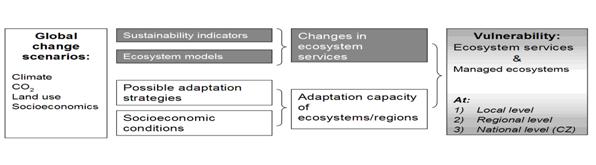
ecosystem services and sustainability of managed ecosystems for the periods
till years 2010; 2020; 2030, 2040 and 2050; Tab.1: Selection
of ecosystem services investigated within the framework of the research project
and definition of indicators that enable their quantification. Numbers
behind individual indicators refer to links with a concrete ecosystem
services within a given managed ecosystem.
2.
evaluate technological, economic, ethical and
sociological feasibility of possible adaptation measures and define the
adaptation capacity of managed ecosystems under current and changed climatic
conditions; 3.
try to combine potential impacts of climatic changes
and the adaptation capacity with the purpose to obtain a parameter describing
the vulnerability of a territory (this will be thereafter generalized for
other regions understudy and, possibly, also for other similar ecosystems
existing in the The main goal of
this analysis of vulnerability is a definition of endangered managed
ecosystems, territories and risky methods of husbandry and a proposal of
suitable adaptation mechanisms. Results of PG5 will be continuously consulted
with stakeholders (including representative of governmental bodies) in such a
way that it will be possible to create conditions for a sustainable
development of managed ecosystems and to preserve the key services, which
they provide. Which are the expected
results? a) Evaluation of specific links existing between indicators of
ecosystem sustainability on the one hand and meteorological phenomena and
climatic processes on the other; b) Evaluation (and/or development) of
simplified ecosystem models, which will enable to describe these complex
linkages; c) Quantification of impacts of climatic changes within selected
time horizons/periods; d) Determination of the adaptation capacity of
ecosystems and of feasibility of adaptation measures; e) Identification of
vulnerability of ecosystems (incl. the possibility of their generalization
for the whole territory of the CR). Regarding the solution of the proposed research
project it is planned to specify altogether five stages of research
activities: During the first
four stages, partial goals 1 to 4 will be solved simultanously in all
ecosystems and obtained results will be evaluated in the subseqent Stage 5 to
obtain a synthesis and, especially, optimized sustainability of all managed
ecosystems under study. The linkage of individual stages is assured by the
use of unified methodologies, experimental localities, joint operation of
investment facilities, consquent
co-ordination of individual workgroups and teams, above all, shared interest
to reach a sustainable development of managed ecosystsems because they cover
54 % of the total territory of the Czech Republic. Stage 1 Biological and technological aspects of
sustainability of ecosystems on arable land Head: Prof. Ing. Jan Křen, CSc. In
the contemporary systems of husbandry, a harmonization of economic use of
arable land in a competitive environment with the need to preserve its
non-productional functions and with efforts to protect soil and the
environment against negative effects of this exploitation is becoming more
and more important. In the Stage 2 Biological and technological aspects of
sustainability of grassland ecosystems Head: Ing. Stanislav Hejduk, Ph.D. In the Recently,
the importance of non-productive functions of grassland has considerably
increased and it can be said that they are often socially more important than
the production of fodder itself. Although the total area of grassland stands
is still increasing, their existence is often dependent on subsidy policy of
the Czech government and EU. Fodder crops on arable land are preferred in
agricultural practice as a source of forage for farm animals with a higher
performance and for that reason it is necessary to spent inefficiently
substantial amounts of money for cutting and/or mulching of those grassland
areas that are not used for production of fodder (it is estimated that they
represent ca 20% of the total area of permanent grassland stands). Low yields
and low quality of fodder are the main reasons of a limited interest of
farmers to use stands with a high abundance of plant species. Tallovin &
Jeferson (1999) emphasised that on these stands yields of forage were at
least by 50% lower than on intensively managed meadows and pastures. Grazing
is the most efficient method of management of permanent grassland stands
(minimum needs of energy supply, lower production but higher quality of
forage, animal welfare). In the past, the research of permanent grassland
stand was focused above all to an intensification of production (application
of fertilisers, herbicides, drainage). Although this resulted in higher
yields and a better quality of forage, the corresponding expenses were often
used rather inefficiently. The intensification usually resulted only in a
rapid reduction of biodiversity (abundance of species) and of some other
externalities. Stage 3 Biological and technological aspects of
sustainability of ecosystems of rapidly growing woody species Head: Ass. Prof. Ing. Pavel Sedlák, CSc. The ecosystem of rapidly growing woody
species is an alternative of agricultural production of arable land and its
purpose is to produce biofuel for facilities with a direct combustion to
produce heat energy or for gasification and a subsequent production of heat
and electric energy. A substitution of classical production of food on arable
land with this method of production is the main reason of this use of
agricultural land. According to the White Paper, which contains tasks agreed
upon within the framework of accession negotiations between the The balance of carbon dioxide as one of the
most important greenhouse gases is an important reason for a global
substitution of fossil sources of energy by production of biological fuels.
When combusting biological fuels for energy generation, theoretically only
that amount of CO2 can be released into the atmosphere, which was
fixed during the process of photosynthesis. This means that the overall
balance of CO2 in the atmosphere is not disturbed and this is an
important contribution to the sustainability of global ecosystems. This
method of the use of arable land leads to the reduction of energy inputs and
(potentionally) also inputs of pesticides and fertilisers (both organic and,
above all, mineral). Soil under a plantation of rapidly growing woody species
is less endangered by water erosion because it is covered with vegetation all
the year round; moreover, as compared with a conventional method of tillage
it can be a refuge for many species of plants and animals and thus contribute
to a higher heterogeneity (and abundance) of the landscape. In spite of
relatively high energy. In spite of a considerable expenses associated with
final growing operations it can be expected that the plantations of fast
growing woody species will not show any permanent effect on a given locality;
however, it is necessary to test the attribute of sustainability of these
plantations from the viewpoint of preservation of soil fertility. The are no
data available in the world literature about plantations of fast-growing wood
species as ecosystems and for that reason it is necessary to identify and
describe all ecosystem services of plantations of fast-growiung woody
species. Stage 4 Biological and technological aspects of
sustainability of aquatic ecosystems Head: Ass. Prof. Ing. Petr Spurný, Ph.D. The In the Stage 5 Analysis of vulnerability and sustainability of
managed ecosystems under conditions of global climatic changes Head: Mgr. Ing. Miroslav Trnka, Ph.D. In the course of the 21st
century the |
A4
Time schedule of the research plan solution
|
The research project is proposed
for a period of six years from the 1st January, 2007 to the 31st
December, 2012. Its time schedule respects the proposed methodology, enables
to coordinate activities of individual workgroups and, in a final effect,
leads to the fulfilment of laid down goals. Data presented in Tab. 2 involve
only the most important activity to illustrate the general time axis and the
logical structure of activities, which are mutually linked up. |
|
|||||||||||||||||||||||||||||||||||||||||||||||||||||||||||||||||||||||||||||||||||||||||||||||||||||||||||||||||||||||||||||||||||||||||||||||||||||||||||||||||||||||||||||||||||||||||||||||||||||||||||||||||||||||||||||||||||||||||||||||||||||||||||||||||||||||||||||||||||||||||||||||||||||||||||||||||||||||||||||||||||||||||||||||||||||||||||||||||||||||
A5
Presumed results of the research plan solution
|
In accordance with partial objectives
of the research project given in part A3 it is obvious that the achieved
outcomes will be related particularly to biological and technological aspects
of sustainability of chosen controlled ecosystems under current and changing
climatic conditions. A survey of the outcomes that can be checked (“what” can be checked is in parentheses): 2007: Ø
complex
elaborated methodologies for determination of chosen indicators and their
grouping - 26 indicators at the first stage (Table 1) that can differ in the
type from the controlled ecosystem (applicable guidelines) Ø
set
up and conduct of field experiments inclusive of their variants, material,
labor force, equipment, etc. (existence of the experiments and records from
their methods) Ø
conclusions
of workshops with stakeholders (documented presentations of investigators and
records of conclusions from workshops as bases for specifying the
investigation strategy) Ø
establishment
of web site of the research project with all information posted to the
site (Internet address of www pages) 2008: Ø
determination
and testing of required values of the indicator group for arable land and
water ecosystems (results of the first year of testing, reviewing scientific
papers) Ø
identification
of “problematic” indicators regarding mutual comparison of evaluated
ecosystems and identification of value intervals of their functionality in
compared ecosystems (specialized papers) Ø
testing
of use of the methodological process under farm conditions – assessment of
availability of the base necessary for determination of indicators from
book-keeping and agronomic records point of view. These farm records include technological
and economic requirements of additional measurements (specialized papers) Ø
calibrated
and tested ecosystem models CERES, GRAM, STICS, WOFOST (databases in the form
of input sets for ecosystem models, specialized papers) 2009: Ø
determination
and testing of required values of the indicators for grass and fast-growing
woody plants (results from two-year testing, reviewing scientific papers) Ø
identification
and analysis of weaknesses of the current management of arable land and water
ecosystems considering their sustainable development (a monograph or
reviewing scientific papers) Ø
use
of tested indicators under farm conditions (guidelines for searching data for
calculating of indicators in practice, a reviewed scientific paper) Ø
acquaintance
of stakeholders with the two-year results of
the research project (documented presentations of investigators and
records of conclusions from workshops as bases for specification of
guidelines and “required” values of indicators) Ø
calibrated
and tested ecosystem models APSIM, SWAP, Climex, Dymex (databases in the form
of input set into ecosystem models, specialized as well as reviewed
scientific papers) Ø
documentation
of seven current various scenarios of climatic changes based on Global
Circulation Models (a reviewed scientific paper) 2010: Ø
identification
and analysis of weaknesses of current management of grass and fast-growing
woody plant ecosystems considering sustainable development (a monograph or
reviewed scientific papers) Ø
evaluation
of contribution of the fast-growing woody plant ecosystem regarding CO2 balance
and relationships to the other examined ecosystems (monographs in the
publication series of the MUAF Brno “Fólia“) Ø
complex
study on biodiversity of controlled ecosystems (a book) Ø
calibrated
and tested ecosystem models CANDY, ECAMON, SPECIES, SECRETS (databases in the
form of input sets into ecosystem models, both specialized and reviewed
scientific papers) Ø
analysis
of impacts of climatic changes and adaptation capacity (in relation to
“weaknesses” found in the sustainability assessment) of controlled ecosystems
(specialized papers) 2011: Ø
auditing
sustainability of farming practices used including impacts on the environment
of individual ecosystem types, the testing of usability of this audit in
order to implement the instruction EU EMAS II
(expertises and studies of model farms) Ø
development
of management practices leading towards sustainability of individual
controlled ecosystems (guidelines containing proposals of their use to
improve “good agricultural practice rules”) Ø
innovated
methods for determination of chosen indicators and their grouping (guidelines) Ø
analysis
of impacts of climatic changes and adaptation capacity of individual
controlled ecosystems (reviewed scientific paper) 2012: Ø
the
third workshop with stakeholders, discussion the results of four-year
optimizing the controlled ecosystems (documented presentations of
investigators and conclusions on introduction of achieved results into
practice) Ø
elaboration
of a complex methodology for evaluation and projecting of sustainable
controlled ecosystems (guidelines, reviewed scientific papers) Ø
analysis
of ecosystem vulnerability and proposal of adaptation measures for ecosystem
sustainability under anticipated climatic conditions (a monograph) Ø
bases
for more effective diversification of subsidies and determination of
priorities of research supporting sustainable agriculture in multifunctional
landscape (a report for the Ministry of Education, Youth and Sports and
Ministry of Agriculture) 2007-2012 (each year): (1) internal publication of results gained
from agricultural terrain and experimental studies in the form of integrated
databases (accessible to investigators and reviewers of the project) (2) organization
of a public control day of the investigators included in group D1 and invited
internal opponents. Results of project solution will be applied in the following manner: Ø
Publications in Czech and international scientific
journals; Ø
Publication of at least 2 special numbers of the
scientific journal „Acta Universitatis Agriculturae et Silviculturae
Mendelianae Brunensis“; Ø
Presentation of methods and discussions about
results with stakeholders and decision makers; Ø
Publication of methodologies; Ø
Dissemination of results among professional public
through papers published in professional journals; Ø
Presentations in scientific conferences and
workshops; Ø
Organisation of professional and consultancy
workshops (including an active presentation in the form of excursions and
lecture cycles); Ø
Establishment and operation of a web homepage; Ø
Presentation of results in courses of MSc and PhD
study programmes; Ø
Development and elaboration of a special software; Ø
Elaboration of research reports suitable for
purposes of the Ministry of Environmental Protection, Ministry of Education,
Youth and Physical Training and Ministry of Agriculture. Publication of results in various
journals: The research
project has a marked character of scientific and developmental work. For that
reason a duty for the publication of results and an exact identification of
financial resources (i.e. the presentation of the number of research
project). Special numbers of the scientific
journal „Acta Universitatis Agriculturae et Silviculturae Mendelianae
Brunensis“ dealing
only with results of this research project will be issued in the third and
sixth year of research activities and will be posted to various prestigious
workplaces both in the Czech Republic and abroad. Presentation
of methodologies and discussions about obtained results with stakeholders and
decision makers): As it results from rules and principles of applied
research, this will be the basic and the most important form of application
of obtained results. In contradistinction to current practice used in the
majority of Czech projects this project envisages an active participation of
some selected representatives of stakeholders (above all farmers, employees
of the management of water catchment areas and of fisheries) and decision
makers (State Phytosanitary Authority, Ministry of Environmental Protection,
Ministry of Agriculture, regional offices of the Czech environmental
Inspection etc.) from the very beginning of formulation of methodology of the
research and defining specific directions of the research. Publication of methodologies: Methodologies that obtain concrete
results are an integral part of scientific work. Regarding the space
available in scientific journals as well as a different approach to the
scientific community the methodologies will be elaborated in a wider scale
with regard to their practical applications. Dissemination of results among members
of professional public:
The character of the research project and its practical orientation requires
direct application of obtained results in individual managed ecosystem and,
in a wider conception, in the
agricultural/rural landscape. A wide spectrum of Czech professional journals
(e.g. Úroda, Zemědělec, Rostlinolékař, zemědělský
týdeník, Obilnářské listy, Pícninářské listy, and Rybníkářství) will be used
as a platform for publication, transfer of information and presentation of
newly obtained data among the widest professional public. Organization of professional and
consultancy workshops:
Professional and consultancy workshops as well as courses of long-life
education represent a contact forum for discussions with users of obtained
R&D results (future stakeholders). Regarding a long tradition and good
experience with the organization of such events at the Faculty of Agronomy
they will represent the most direct form of dissemination of results among
stakeholders and their application in agricultural practice. Establishment and operation of web
homepage: Regarding
the number of researchers, expected outputs/results and potential users of
results of the proposed research project (stakeholders) it is planned to
establish special Internet homepages on the server of the Faculty of
Agronomy, MUAF in Involvement of obtained results in the
educational process:
Besides R&D activities, the mission of each university is to educate
people and to produce young professionals. The results of the research
project will be therefore transformed into lectures, workshops and study
materials for study lines, the curricula of which is related to the general
orientation of the research project. Regarding the number of research team
members (see part D1) and the numbers of warranted subjects and/or lines of
study this form of output assures a high efficiency of dissemination of
obtained results. Development
and elaboration of special software: A number of ambitious scientific projects is
finished and/or supported by means of software applications. Although these
are mostly simplified model tools that are limited by the total amount of
entry data, there is still more and more space for their practical use in the
sphere of pedagogical work. For this reason it is planned to transform some
methodical procedures into the form of algorithms and/or models. Elaboration
of research reports: Annual research reports will be a standard
output that will summarize the obtained results and document the course of
research activities. |
A6
Management, strategies and methods of the research plan solution
|
Each stage of the
research project has a head that is responsible for the fulfilment of set-up
goals (see Part A3). A more detailed survey is presented in the time schedule of research activities
(Part A5) and it is expected that each of them will have two assistants who
will be responsible for the co-ordination of work, supervision and for
control of obtained results. In cooperation with the head of the research
project these persons will control partial research activities including the
guidance of individual experiments and their evaluation from the viewpoint of
sustainability of ecosystems. A survey of individual disciplines and
involvement of warranting workplaces into individual stages of the research
project is presented in Tab.3. Table 3: A survey
of participating departments of the Faculty of Agronomy, MUAF Brno
The research project is based on a scientific analysis of individual indicators presented in Tab. 1. The following text outlines methodical procedures used for their definition in individual managed ecosystems (Stages 1- 4). Methodology for stage 5 will be dealt with separately. Yields
and their stability: Productive (or bioproductive) capacities of
ecosystems will be evaluated on the base of the following yield parameters
(as dependent on further use of their produce): (i) biological yield
(i.e. production of biomass = yields of main product and of by-products),
(ii) economic yield (i.e. yield of the main product), (iii) harvest
index (ratio of economic and biological yields), (iv) yield in
cereal units (using coefficients, conversion of yields of main
product and of by-products of cultivated crops to the yield of cereals). The
last parameter enables to compare productive capacity of systems with a
different structure of crops. Yield stability will be evaluated
on the base of basic statistical characteristics of variability (standard
deviation, variation coefficient, histogram of the density of distribution of
values – asymmetry, excess) of aforementioned yield categories both in
spatial (several fields and several crops) and temporal (several years)
dimensions. In grassland stands,
biological yields are equal to economic yields (evaluated is the yield of
fodder dry matter per year and/or dynamics of its growth during the year).
Using the parameters of quality it is possible to evaluate the yield of crude
protein and net energy per hectare. From the viewpoint of sustainability, the
stability of yields in individual years is a very important parameter. In plantations of fast-growing woody
species, the economic yield differs from the total biological yield and the
yield of wood mass as a basic parameter if given either in defined or
absolute dry matter (t.ha-1.r-1) because of the harvest
within a rotation period. During the growth stage the yield of wood mass will
be evaluated by means of standard methods of yield estimates.
When evaluating the
sustainability of aquatic ecosystem management (production of market fish)
fish production will be estimated with regard to the degree of intensity of
rearing and the natural productive
capacity of water reservoir under study, i.e. as annual production of fish
per unit of water area ( Primary production potential, degree of trophism and availability of
biogenic elements in the aquatic ecosystem: The
total amount of light penetrating through the water column and supply of
carbon dioxide and biogenic elements (N, P) are the factors that control the
intensity of primary production of aquatic ecosystems. The biomass of
producers and their physiological condition and water temperature play also
an important role. The counting of microorganisms and the estimation of
chlorophyll a represent one of the most frequent methods of quantification of
biomass of primary producers. The numbers of phytoplankton after their
thickening in an ultra filtration unit will be counted in Bürker’s chamber
(Marvan, 1957). Chlorophyll a will be estimated according to the Czech
standard ČSN ISO 10260. Numbers of cells and the amount of chlorophyll a
enable to estimate the degree of trophic capacity of water and, thus, also
the degree of its eutrophication. Contents of total nitrogen and phosphorus
and their presence in compounds that are most available for primary producers
(ammonium ions, nitrates and orthophosphates) are the best proven indicators
of the trophic capacity of aquatic ecosystems potential. Based on the knowledge
of the total biomass of primary producers and amounts of biogenic elements in
the system is then possible to predict the secondary productivity of the
animal component of biocenoses of aquatic ecosystems.
Quality of
production: When evaluating the sustainability of methods of management or
husbandry, the quality of production will be evaluated using standards of
quality defined for individual crops (commodities). It is also planned to
perform analytical research, which enables a more detailed evaluation of
quality of production of individual commodities in managed ecosystems with
the objective to explain the main causes of changes in quality and to suggest
corresponding measures. In
grassland stands, the quality of forage is influenced by numerous factors
(botanical composition of the stand, fertilization, date of cutting, method
of preservation etc.). Contents of crude protein, fibre, net energy and ash
/indicating the degree of contamination of fodder) are the decisive (and also
easily estimable) parameters of stand quality. Regarding the fact that the
major part of forage in usually preserved (silage is fed to animals for 200
days per year) it is also necessary to consider the quality of the
fermentation process. In extensively used (i.e. lately harvested) grassland
stands one must take into account also the risk of mycotoxin contamination of
harvested fodder. In
plantations of fast-growing woody species, the quality of production of wood
mass is given by those parameters that determine its use for generation of
energy (combusting, gasification). When evaluating indicators of quality it
is necessary to follow the properties of wood mass during its storage and to
monitor its losses caused by both biotic and abiotic factors during its
manipulation and further processing. The quality of production of fish
biomass will be evaluated by manes of chemical analyses of its quality, including estimations of
the content of poly-unsaturated fatty acids (PUFA), fatty acids (by means of standard methods of gas
chromatography), and residues of some specific pollutants (heavy metals). Indicators of
nutrient balance: In all managed ecosystems the evaluation of the
balance of nutrients is the most important method that enables us to reach
the required values of indicators as far as soil fertility and quality of the
environment are concerned. Individual nutrients may be applied in the form of
both mineral and organic fertilisers. When supplying nutrients, it is
necessary to know their requirements and ecologically acceptable ranges of
their reserves in soil, e.g. the available reserve of nitrogen
(ARN), which expresses an ecologically acceptable content of Nmin
in the soil layer of 0 – Individual
balance of nutrients is characterized as shares of nutrients in inputs
(i.e. in fertilizers) and outputs (i.e. in produce) on all plots. These
balances are ancillary parameters enabling us to monitor slow changes in
nutrient reserves and their required values are ≥ 1. To reach and
maintain the required levels of nutrient balance it is necessary either to
import organic and mineral fertilizers or to export the nutrients through
harvested products. The balance can be evaluated in two different manners:
(i) on the base of a ratio of imported and exported nutrients, (ii) as a
difference between supplied and taken-away nutrients. The
estimation of these parameters enables:
a) In
case of phosphorus and potassium: (i) to estimate the necessary range of
their reserves in soil; (ii) to define plots that should be dressed in
individual years and (iii) to determine the doses of individual nutrients. b) In
case of nitrogen: (i) to estimate levels of available nitrogen necessary
for the attainment of its acceptable contents in ground and surface water;
(ii) to define plots/crops with higher reserves of available nitrogen than
the required range; (iii) to optimize its content by means of integrated
plant nutrition and suitable crop rotations. In grassland stands, attention
will be paid to the use of leguminoses as a cheap source of nitrogen. Further
it is necessary to evaluate the systemic use of manure when assuring the
cycling of nutrients within the farm and trying to increase its independence
on external sources (sustainability). Balance of
organic matter: The organic matter balance will be calculated as a
ratio between annual inputs and outputs of organic matter (i.e. as it supply
and degradation). Plant residues (including green manure) and organic
dressing (t.ha-1) multiplied by coefficients of humification are
defined as inputs. Outputs involve the estimated loss of organic matter
present in soil through decomposition and potential erosion. This balance
should be equal or greater than 1. Farm balances will be expressed as a
weighed mean. Calculations will involve data about: (i) dry matter of
post-harvest residues (t.ha-1) of individual crops; (ii) dry
matter of organic fertilizers (manure, gully, compost, and liquid manure),
(iii) catch crops and ploughed-in straw that remained on fields. Organic matter of wood is the parameter under study
in plantations of fast-growing woody species. The balance of organic matter
will involve the foliage remaining on the plot to assure the cycling of nutrients and the
amount of organic matter in treated (tilled) inter-rows. The monitoring of
organic matter balance is important on heavy soils that show a tendency to
compaction and waterlogging as well as on light ones that are prone to
erosion and drying up. The organic matter balance influences the following
parameters of soil fertility: (i) physical (equilibrium existing among solid
particles, air and soil water); (ii) chemical (content of nutrients as a
result of mineralization of organic matter) and (iii) biological (soil
microorganisms suppressing pathogens and restoring soil structure). Balance
of carbon: The energy-rich crops are used as a substitute of fossil fuels due to
a balanced emission of carbon dioxide within the framework of the use of
biomass as source of energy. For this reason wood biomass from plantations of
fast-growing woody species will be analyzed not only for contents of standard
nutrients and organic carbon; but also for the chemical analysis enabling stechiometric
calculations of potential CO2 emission will be performed.
Theoretical amounts will be thereafter tested by combustion of wood in an
experimental furnace to obtain actual emissions of not only CO and CO2
but also other gases. In addition to a gross indicator „CO2
emissions resulting from energy generation” (OECD) the balance of bound CO2
and that released when generating energy will be calculated together with
carbon residues in ash and in solid soot particles. Consumption of
fossil fuels and energy balance: The balance of energy
expresses the permanent utility value of agricultural products, is not sensitive
to random fluctuations and enables comparison in an objective manner not only
to different types of production but also to different kinds of manufacturing
activities. This energy evaluation can be used as a suitable supplement of
economic analysis. The following parameters are used when analyzing the
energy balance: energy consumption, energetic gain, energy intensity,
input/output etc. The following parameters will be used: (i) energy inputs –
these expressed both direct and indirect energy consumption with a
simultaneous estimation of the share of fossil fuels; (ii) energy outputs –
these correspond with the physical value of combustion heat of harvested
biomass and are derived from yields and composition of dry matter; (iii) net
energy values – energy output (gain of energy), energy intensity and
output/input ratio, which are derived from the energy input, yields a energy
output. Energy consumption of business
facilities and machinery will be expressed by means of energy equivalents
that are adapted and related to the technical progress and modern facilities
and inputs. In all three ecosystems the harvested
biomass will be evaluated on the basis of combustion heat (which is for
individual products specific). In ecosystems on arable land, cereal units
(Woedemann, 1944) will be used as a criterion of aggregation in addition to
values of gross energy. In this way it will be possible to evaluate the
energy balance of not only individual crop turnovers but also of whole
production systems of individual enterprises and to compare different
products on the base of their physiological nutritive value. In
grassland stands, gross energy of fodder will be used as the basic output and
it is expected that the greatest differences in energy balance will be
between pastures (with the highest input/output ratio) on the one hand and
all-year-preserved forage (the lowest i/o) on the other. Until now, this
energy balance of grassland stands has not been presented under conditions of
the As compared with standard crops,
the so-called ecobalance is estimated in energy-rich crops; this value is
expressed as a ratio of energy of inputs to that of outputs in the form of
the main product (wood in the ecosystem of fast-growing woody species). The
output of energy will be evaluated by means of combustion heat and on the
base of heating value of wood biomass and factors influencing it. Soil
degradation: Under this term we understand a number of phenomena that markedly
influence (in this case negatively) the most valuable property of soil, i.e.
it's fertility. Erosion is the most important of them, followed by characteristics
of soil organic matter, compaction, pH, structure, salt content etc. Erosion
shows a negative effect above all on soil fertility and eutrophication of
water. Erosion is caused by the mechanic action of water and wind. Wischmeier
& Smith (1978) tried to develop simulation models of erosion for
conditions of the Content and quality of soil organic matter and humus are factors that
influence those physical and chemical properties of soil that show a direct
impact on parameters of soil fertility. From the ecological point of view the
soil organic matter represents its reserves of carbon and organic nitrogen
and shows an indirect effect on climatic conditions (Christen &
O´Halloran-Wietholz, 2002). Temperature and humidity are factors that
significantly influence the humus content in a given site. Similarly as a
deficiency, also the surplus of organic matter shows negative effects because
it may result in an uncontrolled mineralization and, thus, loss of nutrients.
Several C-N-models have been developed in efforts to estimate changes in the
content of soil organic matter; basing on detailed soil characteristics and
climatic data, these models simulate dynamics of changes in soil organic
matter. As examples it is possible to mention the NCSOIL model developed at
the University of Minnesota, USA (Molina, 1983), the MOSOM model developed in
the Research Institute for Agrobiology and Soil Fertility Haren, the
Netherlands (Verberne, 1990), the ROTHC–26.3 model developed in the Research
Station v Rothamsted, England (Coleman, 1999), the CANDY model developed
in the Environmental Centre in Leipzig, Germany (Franko et al., 1995) and the
SOMNET model developed in the Research Station Rothamsted, England in co-operation with the University of
Aberdeen (Faloon & Smith, 2000). The soil compaction results from a too high pressure of heavy
agricultural machinery on the soil surface. These effects of an increased
weight of machines may be alleviated by a greater width of tyres and the use
of doubled wheels or Terra tyres. In spite of this, however, there are
negative changes in physical properties of soil, especially in the plough
layer and in the subsoil. On
pastures, the compaction of soil may be caused by animals (when applying
unsuitable systems of grazing) and this can be manifested above all in a
decrease in soil permeability, deterioration of soil structure and reduction
of biological activities. Horn & Fleige (2001) tried to model the
development of soil compaction but their results were problematic due to a
combination of too many physical factors so that the interpretation of
results was difficult. The soil structure results from a complex action of physical,
chemical and biological factors. These belong to basic parameters of soil
fertility and maturity. The soil structure will be evaluated on the base of
percentages of individual categories of soil aggregates (coefficient of
structurality) and their stability (water resistance). The pH value of soil influences a
number of chemical, physical and biological properties of soil (e.g. soil
structure, availability of nutrients, occurrence of aluminium ions,
nitrification, activity of soil microorganisms etc.). The buffering capacity
of soil is an important property of soil that is associated with its pH and
expresses the capability to neutralize a part of hydrogen ions so that its
acidity fluctuates within normal limits and resists acidification pressures.
Although they are widely dependent on the weathering of the parent rock,
biological activities of soil microorganisms play an important role in these
processes because they can change the chemistry of the soil environment (Prax
& Pokorný, 1990). For that reason both agronomical and ecological pH
ranges will be defined for individual soils and for different crops. The
biological activity of soil will be evaluated on the basis of
respiration (production of CO2): The basal respiration of soil microorganisms
(BR) is the respiratory activity of microorganisms without any substrate
supplement and it is expressed as the output of carbon dioxide per time unit.
The potential respiration
of soil microorganisms (PR) is the indicator of the
maximum possible metabolic response of the microbial population to the easily
available organic substrate.
The
ratio PR/BR enables comparison to the potential and basal soil respiration
(Parkinson & Coleman, 1991). Its value provides information about limits
of basal soil respiration due to the lack of available nutrients. A small
difference between PR and BR indicates the presence of available organic
material in soil. Under conditions of terrestric managed ecosystems we will
try to establish the release of CO2 from the soil surface
into the atmosphere by means of a classical titration method (for the
estimation of basal respiration). Consumption
of pesticides and the environmental load: The determination of the
need of pesticides is based on their amount used within the framework of
growing technologies of individual crops. At the level of a farm, it is
necessary to calculate weighed means of their consumption for individual
crops per unit area. The calculated requirements are then related to the same
parameter in the reference system (0 < SP < 1). When defining the
required range of values, the following factors are taken into account: (i)
safety and hygienic regulations; (ii) local aspects (e.g. protection zones of
water resources, recreational regions etc.); (iii) local conditions and (iv)
husbandry system or technology of crop cultivation. The objective
should be always to reach values corresponding with 70 % of a standard
consumption of pesticides and/or their active components. The level of 40 %
of the standard consumption can be held as a very ambitious goal. The
load of the environment (atmosphere, soil water) of pesticides is defined on
the basis of residues of pesticides used. Evaluated will be individual
pesticides or groups of pesticides applied for the treatment of one crop,
within one ecosystem or on the whole farm – see methodology published by
Wijnands (1997). Index
of soil vegetation cover (ISVC): This index indicates the extent of cover of
soil surface with vegetation and/or post-harvest residues within the decisive
part of the growing season and/or all year round. A weighed mean of values
recorded on all plots (including the ecological infrastructure and set-aside
plots) represents the value that characteristic the whole farm. This
calculation requires data about the date of sowing/planting, germination and
date of harvest, which should be recorded in technological cards of
individual crops. The range of values: ISVC = 1 (the maximum value) – soil is
fully covered with vegetation and or post-harvest plant residues, ISVC = 0
(the minimum value) – plots are set aside for the whole year. The
share of individual managed ecosystems in the landscape: This will be
evaluated as the percentage of a given ecosystem area in the total area of
cultivated agricultural land (or the total territory of the Heterogeneity
of the agricultural system (the share of ecological infrastructure and the
biodiversity): The compatibility of the environmental protection and the use of
agricultural land is undoubtedly the most complicated aspect of creation of
sustainable production systems (Christen, 1999). The transition between a
natural and cultural landscape has not been clearly defined yet. The
occurrence of some plant species is directly associated with certain tillage
practices and agrotechnical measures and interventions. Haber (1997)
emphasised that from the viewpoint of landscaping and ecology the
extensification does not represent a starting point for sustainable
agriculture. The establishment of all forms of the landscape use – from
extensive to intensive ones – would be more meaningful but always with regard
to the bearing capacity of individual sites. In this context, the
territorial/local systems of ecologic stability (e.g. shrubs, dikes, road
margins, green belts and windbreaks etc.) play a special role and a proper
arrangement of these biotopes can show a positive impact on the system of agricultural production
because it creates favorable living conditions for beneficial organisms on
the one hand and increases the overall biological abundance of the landscape
on the other. The ecological
infrastructure is defined as that share of land area (e.g. within
the framework of a farm or a cadastral territory), which is not used for
agricultural production (and involves protective belts, hedges, escape
coverts, shrubs, balks, landscape corridors for wild flora and fauna etc.).
Territorial systems of ecological landscape stability that create a backbone
of the ecological infrastructure. The ecological infrastructure will be
proposed as a network of balks and dikes along fields and roads with the
following requirements: (i) assurance of variability and continuity of
flowering of plants on the base of their regular cutting and removal of
produced hay to prevent an excessive accumulation of nutrients
(eutrophication) and maintenance of permanent grass belts along dikes as a
means of protection against erosion and leaching of nutrients from fields;
(ii) assurance of variability and continuity of food resources, shelter and
nesting conditions - supported by various subsidiary elements occurring in
banks of dikes and on farms (trees and shrubs, hay-lofts, wood piles etc.);
(iii) assurance of variability and continuity of benefits for holiday-makers
through a great number of sceneries, colours, smells and noises from early
spring to late autumn;.(iv) such a network should cover at least 5% of the
total area of farm. The biodiversity is given by
numbers of required wild species that occur within a given ecological infrastructure
and in a given time interval. As required those species are defined as either
suitable for recreation of people or serve as food or provide shelter for
wild animals. The following estimations will be performed: (i) definition of
differences between required and actual state of an ecological
infrastructure; (ii) definition of differences between required and actual
state of biodiversity both from the spatial (e.g. on farms or in cadastral
territories) and temporal points of view (i.e. in periods that are the most
important for the recreation of people and for the support of migration of
animals); (iii) improvement of ecological infrastructure and biodiversity
(or, possibly, of their too low values as far as the viewpoints of assurance
of a temporal and spatial continuity are concerned); (iv) inventories of
higher plants species will be performed in individual experimental systems
under study and their semi-quantitative representation in some selected
stands will be documented in phytocenological surveys; (v) biodiversity of
grass-herbal associations as a base for the evaluation of anthropogenous
pressures, various methods of use and possible role of given associations
from the viewpoint of their stabilizing functions within the landscape; (vi)
evaluation of diversity of epigeic fauna and phytophages occurring in
individual agrocenoses in dependence on method tillage as an indicator of the
current status and sustainability of productional properties; (vii) effects
of influences of foreign species (expansion, invasion) on the biodiversity of
productional and non-(extra)productional ecosystems with regard to their
causes and consequences. The diversity
of crops can evaluated using the following formula: DC = - ∑ pi
x lnpi, where DC = diversity of crops, pi = frequency of species (from 0.0 to
1.0). Among cultivated crops, percentages of legumes, which enable estimation
of the extent of symbiotic fixation of nitrogen, are mentioned most
frequently; this is followed by percentages of oil plants, cereals, meadows
and pastures in the total area of agricultural land. Water pollution and
eutrophication reduce the biodiversity of many ecosystems and deteriorates
the ecological stability. In running waters, the diversity of Hydrobionts is
significantly influenced by technical
interventions (hydraulic engineering structures and river training), which
result in a reduction of aquatic environment diversity. Associations of
Hydrobionts under study will be evaluated on the base of their species
abundance, coefficient of diversity (Shannon & Weaver, 1963) and
coefficient of equitability (Sheldon, 1969). Basing on an evaluation of
ecological valence of zooplankton species (in stagnant waters) and
macrozoobenthos (in running waters) we will estimate the index of saprobity
(Sládeček et al., 1981), which characterises the degree of organic load of
the aquatic ecosystem within a longer time interval. Special attention will
be paid to the occurrence and population dynamics of individual species of
Hydrobionts because they are indicators of water purity and temperature
changes. Basic physical and chemical properties of
water: Basing on
results of a physico-chemical analysis of water it is possible to evaluate
its quality, degree of anthropogenous load, degree of eutrophication and its
suitability for recreational purposes. Using probes with membrane electrodes,
water temperature and content of dissolved oxygen will be monitored in
selected localities with running and/or stagnant water. The active water
reaction (pH) will be measured potentiometrically by a combined electrode.
Because of a considerable fluctuation, which is dependent on environmental
conditions, it is necessary to estimate these parameters immediately,
directly on the sampling site. The quality of water resources will be
evaluated on the base of the content of organic substances, which are in the
aquatic environment estimated indirectly by means of measurements of oxygen
consumption under given (usual) conditions (CHSKMn, CHSKCr and BSK5). The
aforementioned chemical parameters will be estimated using standard methods
(Horáková et al., 1986). Content of residues of some specific pollutants:
Within the framework of analytical research, contents of some heavy metals
(Hg, Cd, Pb, Cr, Cu, Zn and Ni) will be estimated in muscles of market fish
(pond rearing) and a model indicator species Leuciscus cephalus (in running
waters). Analyses will be carried out using the standard AAS method. The
degree of the load of aquatic ecosystems with these specific pollutants will
be evaluated on the basis of a comparison of concentrations recorded in
different localities and regions with regard to the environmental stress. The
health safety and risks of these food resources will be evaluated on the
basis of a comparison of data obtained for consumed fish (from pond fisheries
and running waters) with valid hygienic limits.
Water
regime: The annual dynamics of
hydrological regime of aquatic ecosystems (in both stagnant and running
waters) belongs to basic factors that influence their primary productive
potential, degree of eutrophication, development and biodiversity of all
hydrobionts and, finally, the overall level of fish production. To evaluate
the effect of a water regime on the aforementioned indicators a statistical
evaluation and analysis of basic hydrological data and their long-term trends
will be performed in experimental localities under study using records
provided by the Czech Hydro-meteorological Institute.
Methodology of the Stage No. 5: The
term vulnerability, which is used throughout this research project,
originates in the definition published by Schröterá et al. (2004), which was
used in the EU project ATEAM. It is defined as ...’a combination of
sensitivity of a given ecosystem service (or a managed ecosystem) to current global
climatic changes and their importance for its users. This definition mentions
three basic spheres of vulnerability. (1) impact of global climatic changes;
(2) sensitivity of the service or the system to effects of the climatic
change and (3) adaptation capacity of
the managed ecosystem and the user of the service’. The purpose of
studies on vulnerability and its causes in various scenarios of the future
development is to prevent the occurrence of losses by means of introduction
of suitable adaptation measures. In the stage No. 5 results of stages 1 - 4
and DC 1 - 4 will be integrated and we also try to interpret the
vulnerability of ecosystem services (incl. effects on their sustainability)
in some managed ecosystems in regions of study (South Moravia and
Českomoravská vysočina Highlands) A
successful analysis of vulnerability (Fig. 2) is based on an identification
of endangered ecosystem services and the assurance of their sensitivity to
the influence of climatic changes. In the first stage of this analysis the
sensitivity of indicators of ecosystem services will be performed (Tab. 1)
concerning: (i) basic climatic characteristics of the region; (ii) annual,
monthly and diurnal variability of climatic conditions and (iii) extreme
hydro-meteorological phenomena (e.g. episodes pf draught). Besides individual
indicators we plan to select (or newly develop), calibrate and evaluate
models of some managed ecosystems (e.g. dynamic models of growth in stages 1
– 3) and ecosystem services (models of soil climate, dynamics of organic
matter, bioclimatological suitability of regions and/or potential area of
wild species distribution) enabling evaluation of complex interrelationships
existing within the ecosystem. This process will run simultaneously with the
evaluation of individual indicators. Our university has a long-term
experience with the development and practical application of mathematic
models of managed ecosystems and presents also (under conditions of the Czech Republic) an
extraordinary portfolio of tools (Tab. 2), which were in many cases directly
linked with GIS (ArcInfo v. 9.0) within the framework of earlier projects,.
Members of the research team deal also with the development of new simulation
tools, e.g. the PERUN-system for the estimation of impacts of climatic
changes on some selected field crops (Dubrovský et al., 2004); the
GRAM-growth model for the simulation of production of meadows and pastures
(Trnka et al.,2006); the ECAMON-ecosystem model for the simulation of spatial
distribution of maize leafroll European Corn Borer (Trnka et al., 2006)) that
have been already tested under different climatic conditions of the Czech
Republic and Austria. After the selection of indicators and ecosystem models
we plan – in co-operation with some invited experts (above all from the
Institute of Atmosphere Physics of the AS CR) – to prepare scenarios of
changes in climatic conditions (incl. socio-economic indicators and data
about the use of the territory) for regions under study; these will be based
on the 4th report of IPCC, several models of global circulation and results
of projects ACCELCEEC and Calim&Ro, in which MUAF researchers participate
for the time being. These scenarios will cover the reference periods of
1961-1990 and/or 1961-2000 as well as time horizons 2020, 2050 and 2080 (and,
optionally, also some others in dependence on concrete and specific needs of
individual ecosystems). Concrete scenarios of climatic changes, GCM models
used and socio-economic scenarios will be based on actual data (e.g. on the
expected 4th IPCC Report) and for that reason they will be specified in
several partial reports. As the indicators of sustainability, ecosystem
models and lists and methodologies of development of adaptation measures will
be the main subject of this research project, it is not possible to present
them in detail here. Examples of indicators, ecosystem models and adaptation
measures that will be used within the framework of the presented research
project are summarised in Tab. 4. Together with
analyses mentioned above we plan to work on the proposal, testing and
determination of adaptation measures and overall adaptation capacity of
ecosystem services and managed ecosystems (both on the level of individual
regions and the whole territory of the CR). The goal of this stage will be to
suggest and test such adaptation that not only will be acceptable from the
biological and physical points of view but also technologically feasible and
ethically and socio-economically acceptable. These solutions must be also
sustainable and should contribute to the stability of managed ecosystems
under study. Regarding a long-term character of some adaptation measures (for
example time necessary for breeding and selection of new varieties, changes
in ecological infrastructure etc.) and a complex character of these problems,
it is planned to start with studies on partial adaptation measures since the
very beginning of the implementation this project.
Fig. 2: A schematic presentation of work progress in the Stage 5. The
basic elements of the methodology are as follows: 1) application of a number
of different scenarios of global changes (climate, CO2 concentration, area
use and socio-economic predispositions) – left box; 2) identification of the
impact of these changes by means of indicators and ecosystem models – grey
boxes; 3) identification of possible adaptation measures and of the overall
adaptation capacity – white boxes; 4) quantification of vulnerability of
ecosystem services and of managed ecosystems on different levels – right
shaded box. Table 4: examples of indicators, ecosystem models and adaptation
measures considered within the framework of the project proposal (a
definitive selection, verification and application are the subjects of the
research project). Numbers behind ecosystem models identify the managed
ecosystems.
The research team
is fully aware of the fact that biological and physical aspects or – in an applied concept – the biological
and technological sustainability study is (besides social and economical
ones) only one of possible dimensions of sustainability. However, from the
viewpoint of the landscape and its managed ecosystems, this dimension is
crucial. A successful solution of goals of this research project, in which we
emphasize the approach to the cultural landscape as a provider of ecosystem
services, is probably the only way to assure its sustainability. Note: All
literature and references to all ecosystem models are available by at the
workplace of the applicant and on the Internet address: www.mendelu.cz/~opr/vz.htm |